
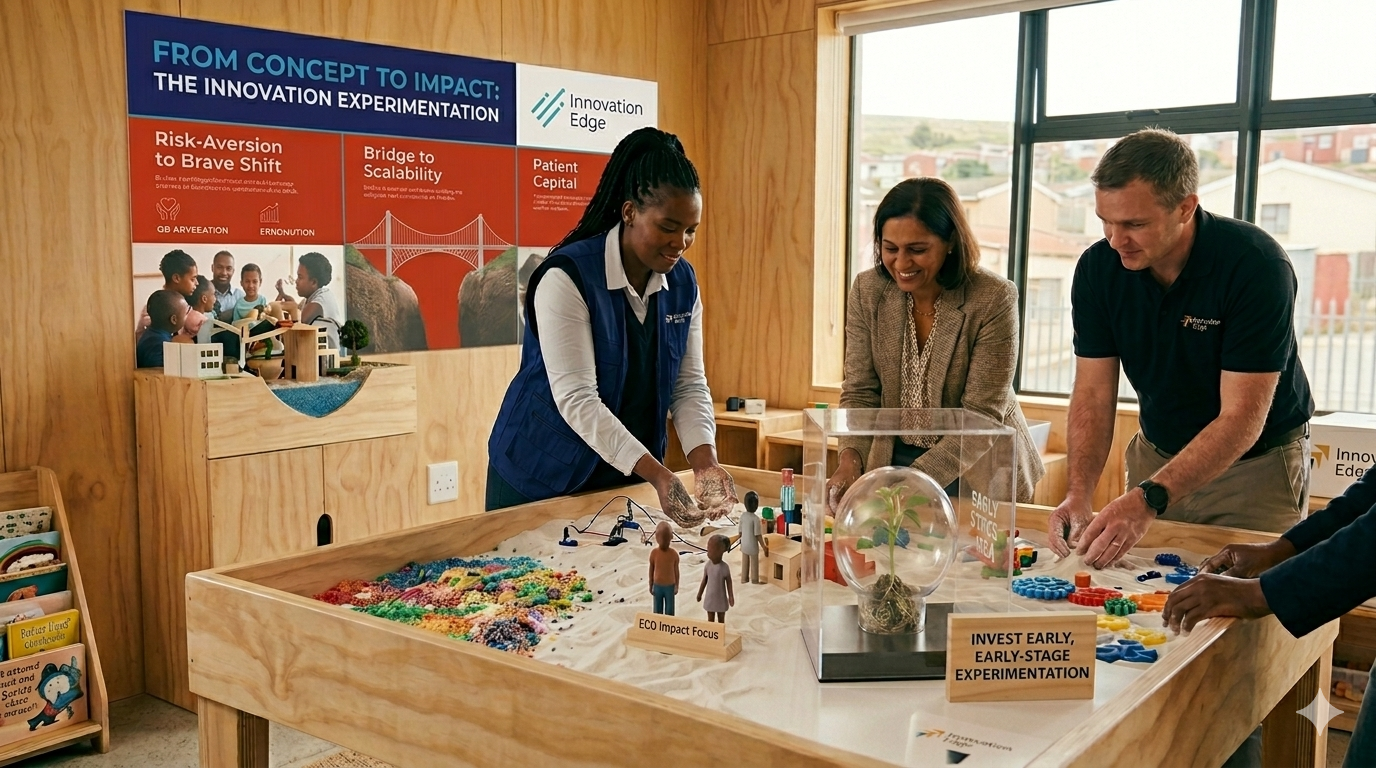
Today, on World Creativity and Innovation Day, the global spotlight turns to ideas – how they begin, how they grow, and how they ultimately shape the world around us. In South Africa, where the challenges facing young children are complex and deeply rooted, creativity and innovation are essential. But bold ideas alone are not enough. They need the right kind of support to move from concept to impact.
In this Q&A, Salma Seedat, Executive Director of Innovation Edge, shares what it really means to take an impact-first approach, and how backing early-stage ideas can unlock solutions that improve outcomes for young children:
Impact-first investing is often described in technical terms. In your experience, what does it really look like in practice, especially in the early stages of an idea?
In practice, impact-first investing is having the courage to collaborate with a social entrepreneur before they have a polished pitch deck or a proven track record. It means prioritising the potential social return or impact, which in our case would be improving the life-long success of a child, over immediate financial gain. For IE, it’s about creating a space for early-stage experimentation, where unproven ideas can be tested for their potential to disrupt systemic failures. It’s less about a transaction and more about a partnership that is aimed at solving a specific problem for the poorest 40% of South Africa’s children.
Where do you see traditional funding approaches falling short when it comes to supporting early-stage, high-impact solutions?
Traditional funding often struggles with risk-aversion. Most donors and investors wait for a proven model before stepping in, which inadvertently creates a “valley of death” for early-stage ideas. This leaves social entrepreneurs with brilliant concepts but zero capital to build a prototype or run a critical pilot. Beyond the capital gap, traditional approaches tend to be siloed, providing the money but lacking the capacity to offer the technical, non-financial support and business-minded coaching a social enterprise needs to survive its first five years. This is exactly where Innovation Edge steps in. We intentionally de-risk innovations that possess high-impact potential for the ECD space. By providing hands-on support to founders and their teams throughout their journey, we help bridge the gap from a fragile early-stage idea to a viable, established social enterprise.
Innovation is often spoken about as of utmost importance, yet many early-stage ideas struggle to get funding. Why do you think that gap persists?
The gap persists because of a fundamental mismatch between the radical innovation required to solve ECD challenges and the certainty that most funders require before committing capital. Real innovation is inherently messy; it rarely follows a linear growth path and carries a high risk of failure. Unfortunately, most traditional funding structures are not designed to “learn from failure.” As a result, they gravitate toward safe, incremental improvements rather than the brave, systemic shifts required to truly move the needle on child outcomes. Innovation Edge bridges this gap by acting as a catalyst. We intentionally absorb that initial risk to get high-potential social enterprises off the ground.
In your view, what is it about an impact-first approach that makes it better suited to supporting early-stage innovation?
An impact-first approach provides “patient capital.” It acknowledges that solving deep-seated social issues like stunting or early literacy takes time. Because our primary metric is impact, we are not pressured to force a venture into premature profitability. This gives the innovation the breathing room it needs to iterate, fail, pivot and eventually find a scalable path that truly works for the community that it serves.
Can you walk us through how this approach shows up in practice at Innovation Edge, particularly in how you fund and support solutions?
In practice, this means we deploy a versatile range of financial instruments tailored to a social venture’s specific stage, moving from pure grants to convertible instruments that can transition into loans or equity as a venture matures. However, the funding is only half the story. Our Portfolio Management team provides intensive technical assistance that goes far beyond the funding we provide. We assist with everything from refining a project’s pedagogy to establishing robust Monitoring, Evaluation, Research, and Learning (MERL) frameworks. Crucially, we provide the strategic connections to ecosystem stakeholders necessary for a venture to scale. We stay deeply embedded with our investees, helping them navigate the unique complexities of the South African ECD ecosystem.
Innovation Edge speaks about “investing early.” What does that mean in practice?
For us, “investing early” carries a critical double meaning. First, it refers to the biological window: we focus exclusively on the first six years of a child’s life, as this is the period where the highest possible return on investment for human capital exists. Second, it refers to the investment window: we enter a social enterprise’s journey at the seed stage. While other funders often wait for growth-stage ventures with proven track records, we are in the trenches during the inception phase, planting the seeds and helping promising ideas move from a raw concept to a viable, scalable and impactful entity.
What role does/can the wider ECD ecosystem play in making early-stage innovations scalable, and where do you see the biggest gaps today?
The ecosystem should ideally act as an accelerator that absorbs and integrates proven innovations into both the public and private sectors. Currently, however, the most significant gap is fragmentation. We have many brilliant social enterprises providing essential products and services that bridge critical gaps in the ECD sector, but they often operate in isolation, disconnected from the wider system or government policy.
To achieve real impact, we must move these ventures away from figuring out pathways to scale on their own. We need to shift toward a more collaborative model where government, NGOs, and the private sector work together to pull innovations through to national scale, ensuring that the best solutions reach the children who need them most.
If South Africa wants to really focus on improving outcomes for young children, what needs to shift in how innovation is supported?
We need a fundamental shift from “supporting programmes” to “supporting systems”. While we are starting to see the fruits of system-building work through more collaborative efforts in the 4-to-6-year age group, those same efforts are not necessarily replicated for our youngest children. We must refocus that same collaborative energy much earlier, specifically on the 0-to-3-year window, where the foundation for all future development is laid.
This requires us to be more intentional about identifying where the systemic gaps are, such as in caregiver and maternal health support, and moving away from “innovation for innovation’s sake”. Improving outcomes for South Africa’s children demands that we have the courage to move beyond our silos, align our language and reinvent our roles to meet the needs of an evolving ecosystem.
This reflection leaves us with an important insight. Impact-first investing is about recognising that the most meaningful solutions rarely arrive fully formed. They begin as early ideas that need space, support, and the willingness to engage with uncertainty. When we shift how we think about risk and value, we create room for innovation to grow in ways that are grounded in real contexts and real needs. That is where impact begins to take shape.
Read more insights here, and get in touch if you have any innovative ideas to address challenges in early childhood.
Author: Salma Seedat – Executive Director at Innovation Edge
Co-Author: Dimpho Lephaila – Communications Associate at Innovation Edge